Fixed-price audit
Consent Verification Report
We load your site three times: once clean, once accepting consent and rejecting it, and once with the Global Privacy Control signal set. Then we report what your trackers actually did, tracker by tracker, in a dated PDF your counsel or DPO can file.
- Delivered in 2 business days
- No subscription, no scan credits, nothing to cancel
The lead check
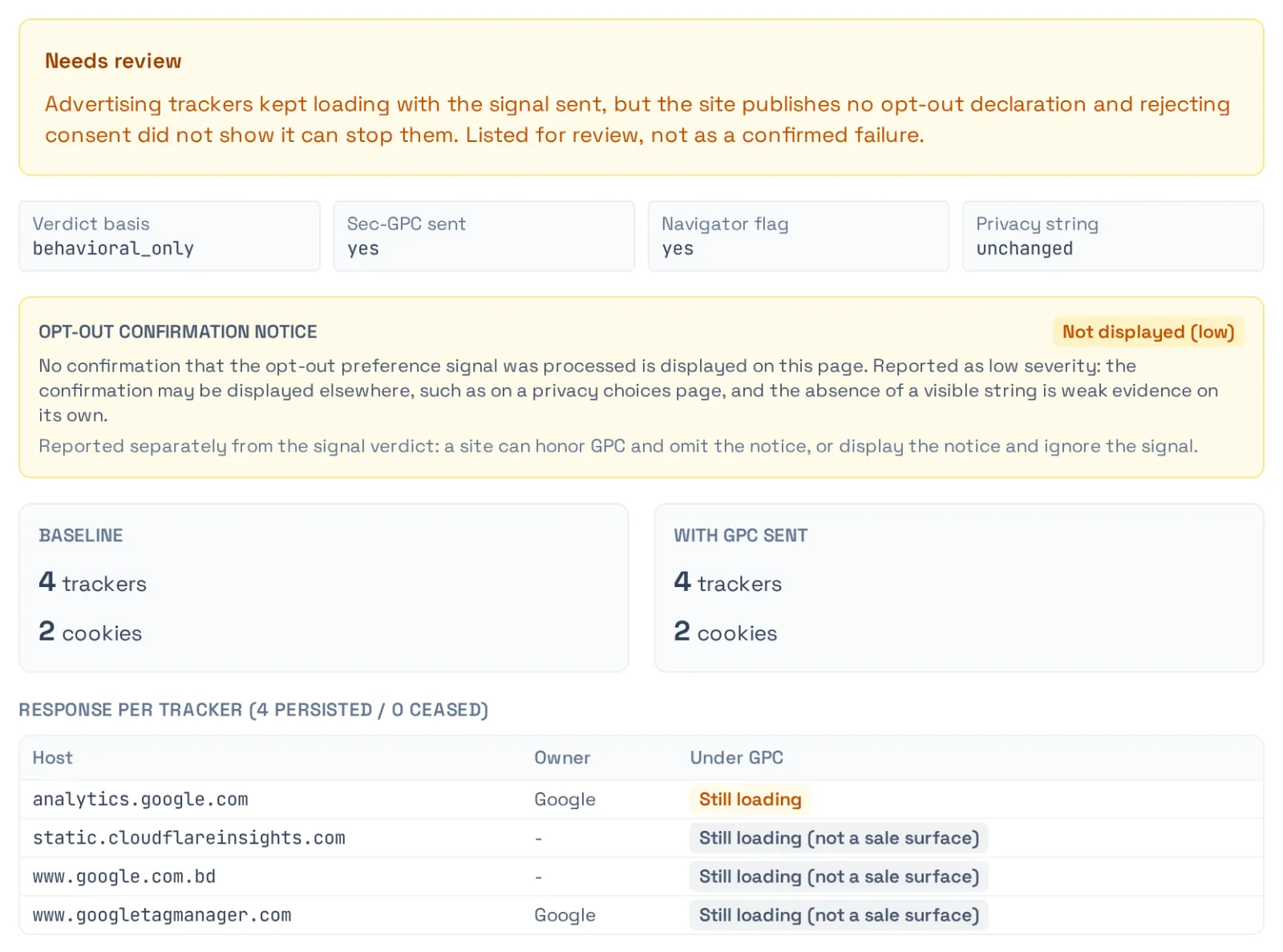
The Global Privacy Control check
A cookie banner is a consent interface. The Global Privacy Control signal is a legal instruction, and it arrives before any banner is clicked. Several US state privacy laws require a business to treat it as a valid request to opt out of the sale or sharing of personal information. California is the most explicit about it: Civil Code section 1798.135(b)(1), as implemented by 11 CCR 7025.
It is also the rare compliance duty that is testable from the outside. We send Sec-GPC: 1 on every request, set navigator.globalPrivacyControl for page scripts, reload the site, and compare it against the pre-consent baseline. The report names every advertising host that kept loading anyway, and separates the ones your own site is known to suppress when consent is rejected, because those prove the capability existed and was not used.
Your report also records whether the confirmation the California regulations ask for is displayed anywhere we could see it, and whether your published US Privacy or Global Privacy Platform string reflects the signal. Both are reported as observations rather than as verdicts, because a confirmation can live on a page we did not load.
What you receive
What is in the report
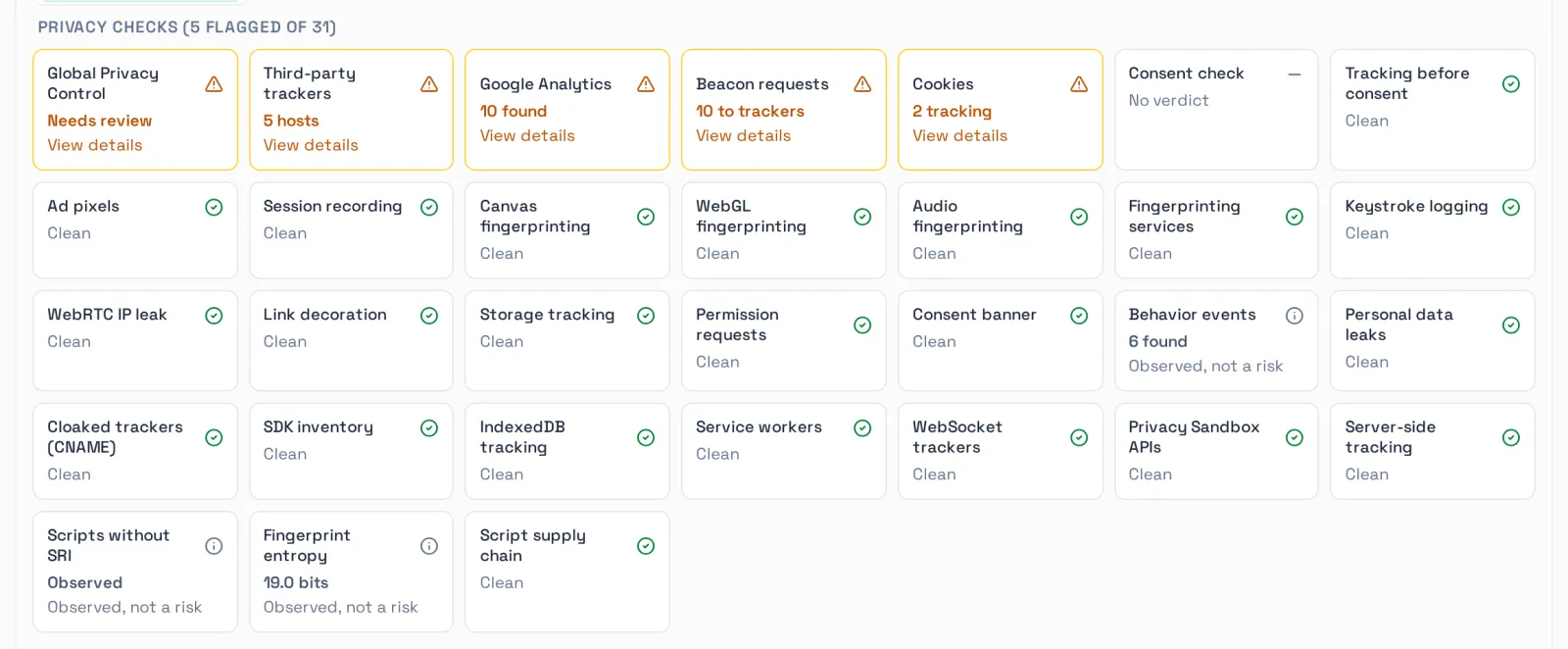
Everything below is something the scan measures in a real browser on your live site. Nothing is inferred from your privacy policy or from a questionnaire.
Global Privacy Control
Accept all against Reject all
Firing before consent
Tracker and pixel inventory
Session recording and keystroke capture
Fingerprinting
Your consent platform
Data leaving the page
Then the part that makes it usable: a privacy score and grade, your privacy policy's disclosed third parties compared against the ones we actually observed, and a remediation note per finding. Dated, per-page, and yours to hand to counsel.
How it works
- You send us the domain and written authorization to test it. We do not scan a domain before that authorization is in writing, ever, and it has to come from someone able to give it.
- We run the audit in a real headless browser against your live site, sampling your landing page and internal pages, with a mobile browser profile.
- You get a dated PDF within two business days, with the per-tracker tables above and remediation notes on the gaps it ranks highest.
Who buys this
Privacy counsel, a DPO, or the marketing-operations lead who owns the tag manager. Usually because a banner was installed, signed off and never verified, and somebody now needs to know whether it does what it claims. It is also the right first step when a tracker showed up in a complaint, a questionnaire or a demand letter and nobody can say when it started firing.
If you would rather run it yourself and keep running it, the same privacy engine is in the product on scan credits, and continuous monitoring will re-check a domain and tell you when tracker behavior changes. This page is for the one-off deliverable with a price you can approve without learning a new unit.
What this is not
- It is not legal advice. We report what your site did. Whether that breaches a particular statute is a judgement for your counsel, and the report is written to be handed to them rather than to substitute for them.
- It is not a certification. This is a dated record of what your site did when we measured it, not a mark anyone accredits.
- A crawl sees the pages it walked. We sample your landing page and internal pages, and the report says which URLs it covered. A tag that only fires at checkout, behind a login, or in a region we did not test is not in it.
- A request to an ad host is not proof of a sale. Where the evidence supports a concern rather than a violation, the report says concern and says why. We would rather hand you a finding that survives a lawyer than a scary number that does not.
Questions
What is the Global Privacy Control signal?
A browser-level opt-out preference signal, sent as the Sec-GPC request header and exposed to page scripts as navigator.globalPrivacyControl. Several US state privacy laws require a business to treat it as a valid request to opt out of the sale or sharing of personal information. California is the most explicit: Civil Code section 1798.135(b)(1), as implemented by 11 CCR 7025.
Do I need a subscription?
No. The Consent Verification Report is a one-off deliverable at 199 USD per domain, priced outside the scan-credit system. There is nothing to cancel.
How long does it take?
Two business days from written authorization.
What do you need from me?
The domain, and written authorization to test it from someone able to give it. We do not scan a domain before that authorization is in writing.
More than one domain
Multi-domain and agency pricing is quoted per engagement, which is how this usually gets bought anyway. Tell us how many domains and whether you need one consolidated summary for the account or a separate report per site.